
Preventing overheating in buildings?
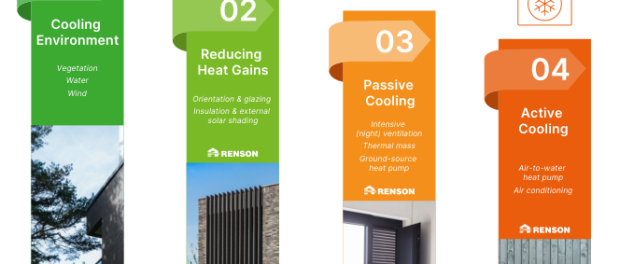
The Ladder of Cooling as a guideline for heat-resistant building design
We’re experiencing periods of more intense heat due to climate change. Those periods are getting longer and it also stays hot at night more frequently. Several studies suggest that this trend will continue. As an architect, it is therefore better to include this current challenge right from the building design stage in order to design future-proof buildings that guarantee sustainable and energy-efficient comfort in both winter and summer.
By including summer comfort structurally from the design phase, you minimise the overheating risk of a building. A lot of factors come into play and it may seem like a complex tangle. Fortunately, there are handy tools, such as the Ladder of Cooling. This framework from the Dutch OSKA (Overleg Standaarden Klimaatadaptatie/Climate Adaptation Platform Netherlands) gives you guidance and a clear order of the most appropriate measures. In fact, with outdoor sun protection, night cooling, and heat pumps in the range, Renson already covers a lot of the solutions from the four steps on the ladder.
- Provide a cool environment
Look beyond the building itself. Because green and blue help keep the immediate surroundings of homes cool, laying the foundation for pleasant indoor temperatures. Plants, water features, openness between buildings, etc. all contribute to the basis for a comfortable indoor climate. - Beat the heat (even before it gets inside)
As an architect, you can make the real difference in the second step on the ladder with smart building design, from building orientation and glazing to reducing heat loads on the glass with strategic shading and efficient outdoor sun protection.
An overhang, Renson outdoor sun protection, such as subtly integrated screens, as well as architectural accents in the form of structural sun protection or Loggia sliding panels do the job excellently. With solutions for vertical glazing, glass-on-glass corner windows, dormers, Velux dormers, etc., Renson also happens to have a suitable solution in its range for every application. Nice touch: the Fixscreen Minimal also fits perfectly on minimalist windows. Coated in the same colour as the joinery and/or recessed into the façade, these screens hardly have any impact on the façade appearance.
- Facilitating passive cooling
Has the heat still managed to seep inside? Then the first solution is to combat it with passive techniques, such as night cooling in the form of burglar-proof and insect-proof louvres recessed into the windows. Then cooler outside air ‘flushes’ the house at night so that by the next morning, the thermal mass has lowered the thermometer by several degrees.
Passive cooling techniques can make a pleasant difference, but they are not miracle remedies. This is precisely why sun protection and passive cooling are an and-and story. Regardless, it comes down to anticipating how the indoor areas will heat up as much as possible.
- Active cooling provided for highest need
Active cooling is still sometimes appropriate in cases of extreme heat or prolonged hot periods – especially if there is little cooling at night. An air conditioner or a heat pump can therefore be useful, but only as a last resort to deal with peaks.