
Architecture That Shapes Place
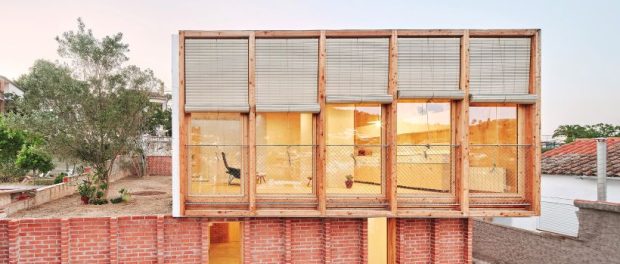
A project by Ágora Arquitectura recognised by the APE Grupo Architecture Awards
“Architecture should not impose itself on a place, but learn from it.” This idea -shared by several generations of architects who understand the discipline as a form of dialogue with what already exists- lies at the origin of “House on a Brick Plinth”, a project developed by Ágora Arquitectura in Sant Vicenç dels Horts (Barcelona, Spain). An approach that aligns with the perspective promoted by the APE Grupo Architecture Awards, recognising works that understand architecture and ceramics as tools serving a way of living.
“Every project begins with a very careful reading of the site,” explain architects José Luis Cisneros and Joan Casals. “The location, what already exists, the materiality, and everything we are able to recognise by observing the place ultimately shape how we act. Before designing, we gather all these ideas, and from there we give form to the architecture.”
The house is developed on a plot with two clearly differentiated levels, located in a residential environment around twenty kilometres from Barcelona. Two small disused structures -an old tool shed and a ruined building- become the starting point for an intervention that results in a two-storey single-family home, establishing a clear relationship between the existing terrain and its former ways of inhabiting.
The house is organised around a brick plinth that contains the land and defines the base of the project, supporting a lighter structure above. “We use brick because it is a material native to the area and connects directly with the clay-based nature of the ground,” explain the architects, highlighting a construction logic rooted in what already exists. On this base, the project proposes “a conscious balance between craftsmanship and prefabrication”, establishing a precise relationship between a heavy system linked to the earth and a lighter upper volume made of cross-laminated timber (CLT).
The upper floor accommodates the main uses: two bedrooms connected by a partition-cum-bookshelf, a bathroom lit from above, and a flexible living and kitchen space that opens onto the dining area. The lower floor, in direct contact with the ground, houses a second living room, an additional bedroom, a bathroom, and service areas organised around a structural wall.
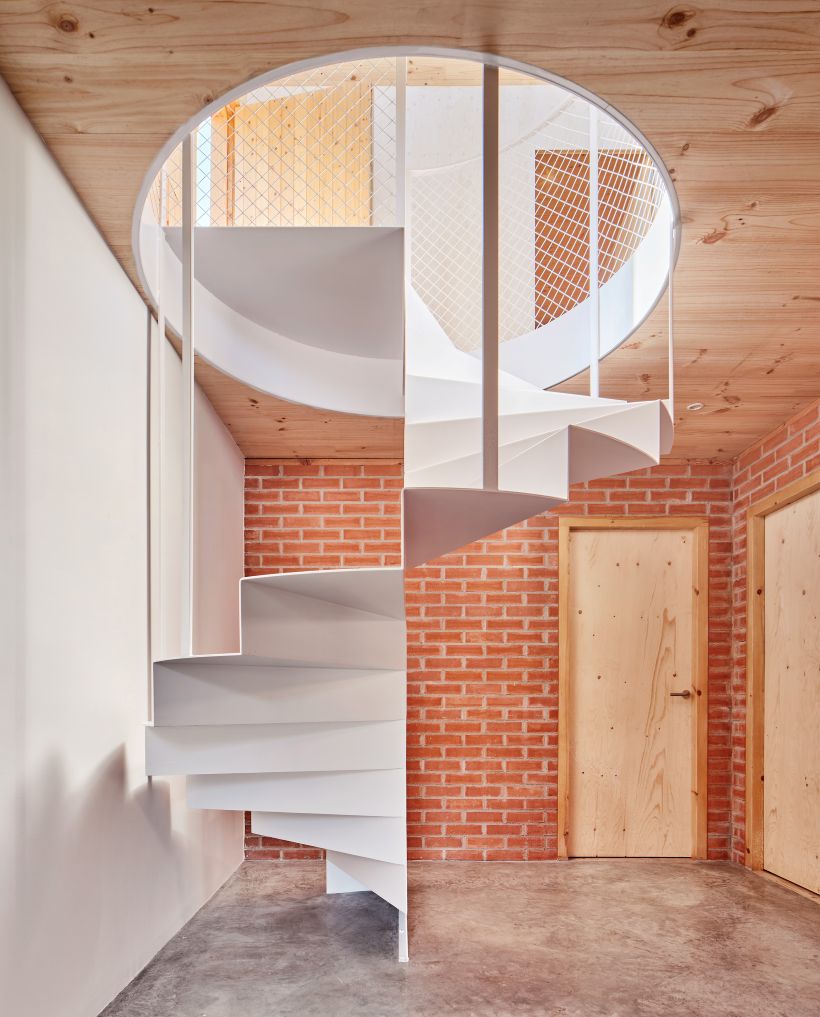
Ceramics as a link between light and living
Ceramics appear in the interior of the house associated with the most intimate spaces and in dialogue with natural light. In the bathroom, glazed ceramic tiles in shades of blue establish a direct relationship with light and the exterior.
“We were seeking a connection with the sky, harmony and continuity,” they explain. “The colour is not intended to take centre stage, but rather to blend with the light entering from above and connect that space with the outdoors.”
This way of building responds to a very specific understanding of materials.
“We are interested in construction materials that function directly as finishes—materials that remain true to what they are,” they explain. “We appreciate ceramics in simple formats and finishes, using them with a logic of austerity and in the pursuit of results that can be highly precise.”
The relationship with the street is resolved through the continuity of the same plinth that forms the retaining structure. A perforated brick wall and a double-opening gate filter views into the interior, avoiding direct exposure of domestic life. The entrance is conceived as a gradual sequence that introduces visitors progressively into the home and reinforces the transition between exterior and interior.
Beyond its specific solution, the project reflects an understanding of architecture rooted in responsibility.
“We aim for the project to transcend our own limits of intervention and contribute something beyond the built object. It should be sensitive to its surroundings and capable of respecting both the individual and the collective,” explain the studio.